
Looking beyond the score: What 707 Year 8 students revealed about science learning
Betelgeuse is around 700 light-years away. Every time we look at it, we are seeing the star as it was in the 1300s. Most school assessment data does not travel quite that slowly… although it can sometimes feel that way.
In late 2019, Betelgeuse suddenly dimmed by about 60%. The change was obvious; the cause was not. Astronomers had data, but the data did not hand them a neat conclusion. They kept observing, compared evidence and investigated the signal before deciding what it meant.
Assessment data presents a similar challenge. A score is an observation. It tells us what a student selected or wrote at one point in time, but not necessarily why. Was it a vocabulary gap? Content they had not encountered? A persistent misconception?
That is the idea behind MESHA—the Maths, English, Science and Humanities Assessment. It is not another score to file away or a leaderboard for ranking schools. It is a shared formative assessment designed to give teaching teams comparable, question-level evidence while there is still time to act.
Science is not maths in a lab coat
Science brings a particular challenge. Its topics do not always build in a tidy sequence. A student can learn about ecosystems without first studying cells, while forces, rocks and chemical change may be taught at entirely different points of the year. Gaps can remain hidden for months.
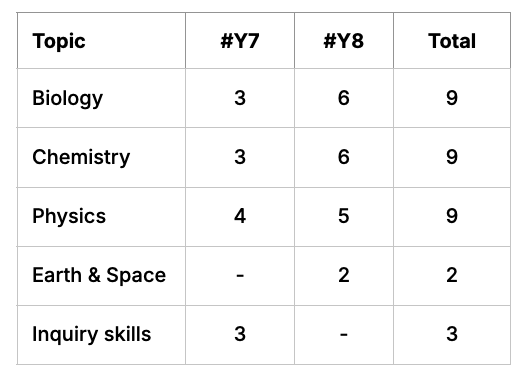
In our Year 8 Science pilot, 707 students across six schools completed 32 items covering Biology, Chemistry, Physics, Earth and Space Sciences, and Science Inquiry Skills. Each incorrect option was linked to the thinking it might represent, allowing us to look beyond how many students were wrong and investigate what reasoning may have led them there.
When the average is only the beginning
Across the pilot, students answered an average of 43.4% of Physics items correctly, compared with 59.7% in Biology, 59.1% in Chemistry and 78.0% in Science Inquiry Skills. These domain averages are directional rather than direct comparisons because the items were not equated for difficulty. However, Physics looks like the obvious curriculum priority. But the average cannot tell a science leader whether to allocate more teaching time, change how particular ideas are taught or focus on a smaller set of concepts. For that, we need to look beneath the domain label.
The item-level results told a more useful story: the learning gaps were concentrated in forces and energy representations, while thermal energy questions were comparatively strong. Rather than revisiting all of Physics, a teaching team can examine how forces are modelled, how students interpret energy representations and whether these ideas receive enough attention in the curriculum.
The Chemistry average concealed a different issue. Students were strong when identifying particle arrangements and explaining boiling, with 86% and 85% correct respectively. Yet only 21% could apply the particle model to explain evaporation from the surface of a liquid.
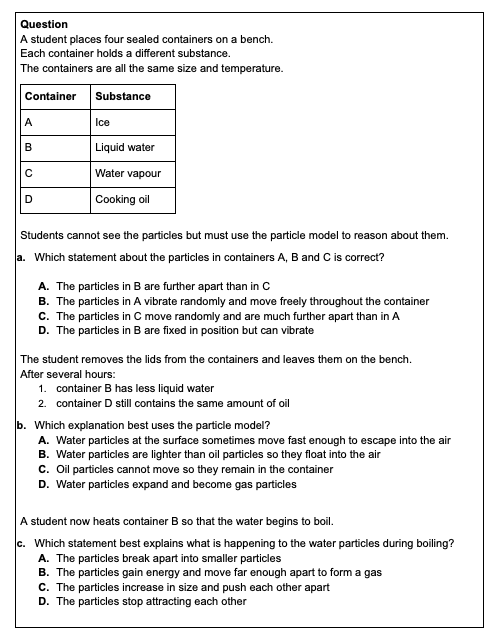
That contrast matters. Students appeared to understand familiar particle diagrams and explanations of boiling, but struggled to transfer the model to a less familiar phenomenon. This may indicate that the particle model has been learnt primarily as a description of solids, liquids and gases, rather than as a model students can use to explain what they observe.
For a science leader, that finding has implications beyond the Year 8 unit. The particle model underpins later learning about diffusion, gas behaviour, physical and chemical change, and chemical reactions. The incoming Year 9 cohort may therefore need deliberate retrieval and further opportunities to apply the model before those more complex ideas are introduced.
This is the useful part of the data. MESHA does not simply report that Physics was weaker than Chemistry, or that an evaporation question was answered poorly. It helps leaders move from a broad result to a more precise curriculum question: What do students know, where does their understanding stop, and what future learning depends on it?
From interesting data to instructional action
Because participating students complete the same assessment within a shared window, science leaders gain a genuine comparison point across classes, cohorts and like schools. Reports are returned within 10 days, while the same students are still in front of us and there is time to respond.
The question-level patterns can help a faculty ask:
- Is this gap shared across the cohort or concentrated in one class?
- Is one teacher’s class performing unusually well on a concept—and what can the team learn from their approach?
- Does the response pattern suggest missing knowledge, a persistent mental model or a question that needs review?
- Is the right action targeted reteaching, retrieval practice, curriculum adjustment, extension or further investigation?
At cohort level, the findings might lead to a change in curriculum sequencing or targeted retrieval before the next linked concept is introduced. At student level, they can help identify who is ready for extension, who needs additional support and inform decisions about class placement and streaming alongside teachers’ professional judgement.
At team level, the data can surface effective practice that might otherwise remain inside one classroom. The value is not simply having more data. It is being able to make better decisions about what to teach, when to teach it, how to group students and where to draw on expertise across the team.
In astronomy, a telescope does not tell a scientist what to think. It makes previously invisible signals available for interpretation. That is how I see MESHA: not replacing teacher judgement, but sharpening it.
And unlike the light from Betelgeuse, the signal arrives in considerably less time!
A big thank you to the teachers and students at our six pilot schools. Their participation and feedback helped us test the assessment, understand what the results could, and could not, tell us, and improve MESHA for the schools that follow.
The 2026 Science MESHA assessment window for Years 7–9 runs from 15–28 October 2026. Schools receive their insights within 10 days, and an existing Edrolo subscription is not required. Register your interest in participating in the next MESHA for Science.