
MESHA Case Study – Knox Grammar
MESHA misconception data is helping Knox Grammar’s Maths faculty move from intuition to evidence, and lays the groundwork for a Year 7 to 12 view of exactly where, and why, students lose marks.

In Term 3 2026, 387 Year 8 students across 16 classes at Knox Grammar School completed Maths MESHA, the school’s second MESHA assessment.
For Andrew Siu, a Mathematics teacher at Knox who drives the faculty’s data work, the value of MESHA was never a headline score. It lies in the specific misconceptions that, left alone, follow students all the way to their HSC exams.
The non-routine question problem starts in the junior years
Andrew recently presented at the mathematics conference “MANSW” where one question kept surfacing across workshops: how do we support students who struggle with non-routine HSC questions? The pattern is familiar to every senior Maths teacher. The moment an HSC question looks unfamiliar, the state average drops.
As Andrew explains, ‘yes, the questions are difficult, but it’s got something to do with the junior years and a lack of foundational understanding’. Students don’t fail non-routine questions only because they are hard. They fail because the concepts those questions are built on were never secure in the first place.
The difficulty for schools is proving it. Without precise diagnostic data, the link between a Year 12 result and a Year 8 gap remains a hunch.
‘The education space is so complex, and we’re really just guessing until we get specific data. I think MESHA fills that gap.’
From educated guess to evidence: the true bearings example
At the MANSW conference, Andrew shared a telling example. A three-dimensional trigonometry question involving true bearings was performed poorly across the state. Most Maths teachers would offer the same intuitive explanation: students are weak in angle relationships.
Andrew’s point to the room was that Knox no longer has to rely on that intuition. ‘At our school we use MESHA so that we’re not guessing,’ he says.
‘With MESHA we can be certain that the Year 7 and Year 8 cohort is a lot weaker in angle relationships. They don’t understand the concept of alternate angles and co-interior angles, and that’s an important skill to have as you grow into bearings.’
That shift, from a plausible theory to a confirmed, named misconception, changes what a faculty can do. It connects a senior topic to the junior concepts it depends on, and it tells teachers exactly what to reteach, and when.
Why a strong average still hides pockets to reteach
The headline result doesn't tell the whole story. When Andrew isolated the results for Knox's mixed-ability core classes in the MESHA pilot data, those classes were 'actually average, if not below average, for some of the specific topics. So it was still very helpful
The same holds within individual questions. Reviewing the Term 3 results, the Knox team looked at a multi-event probability question. In one class, 42% of students chose the same incorrect answer, treating the problem as with replacement rather than without replacement. A second group calculated the probability of only one event. The same clustering appeared across different classes, including classes that performed above average overall.
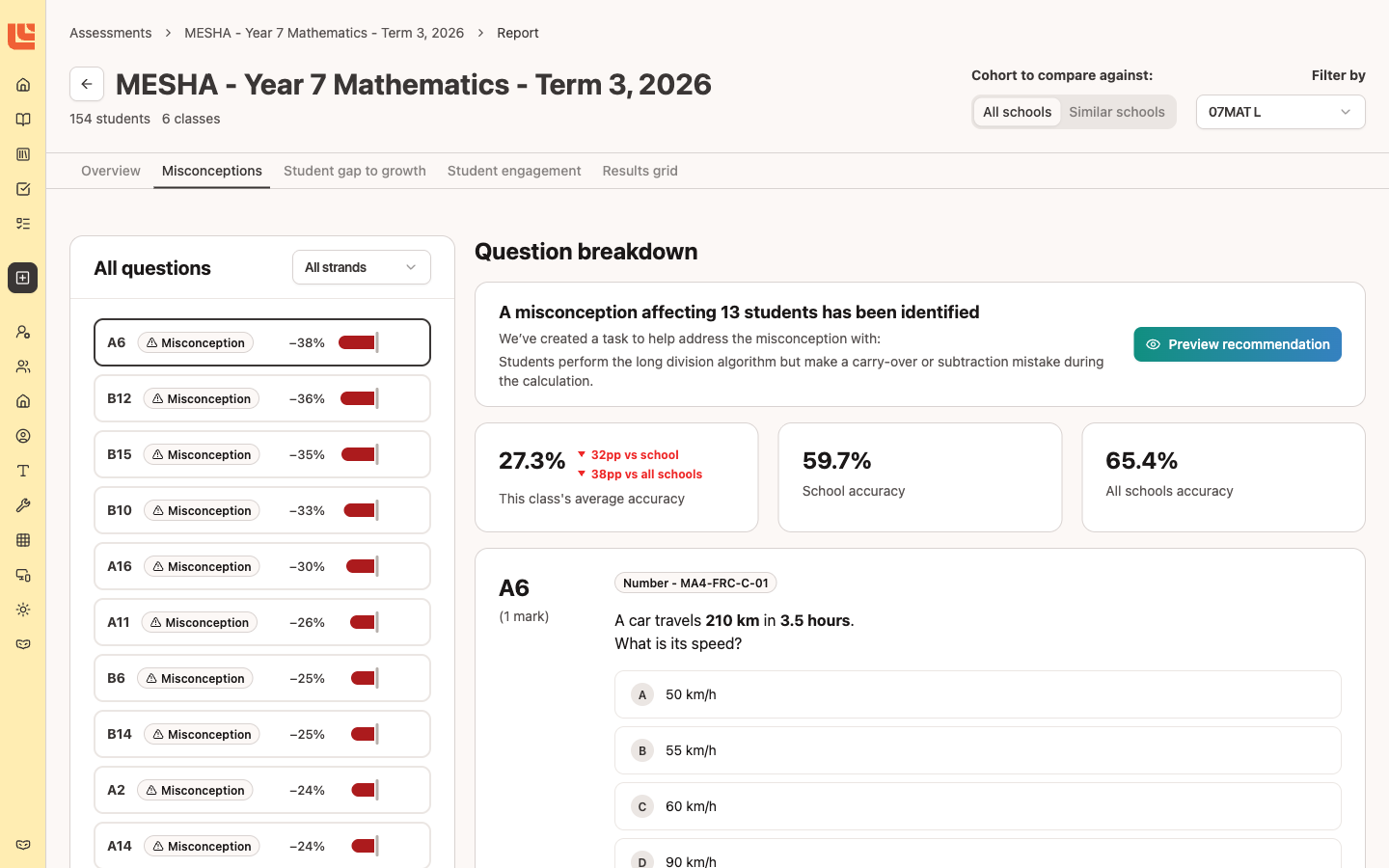
This is the pattern MESHA is designed to surface. Even in a high-performing class, the students who get a question wrong tend to land on the same misconception. That makes the fix targeted rather than general, and it is why the MESHA dashboard now pairs each misconception with recommended Edrolo tasks that teachers can assign to address it directly.
For Andrew, the probability finding is exactly the kind of evidence that carries weight with colleagues. Once senior results arrive, he says, ‘it would be so easy to pinpoint why probability has been performed lower than the state average, and link that to MESHA’.
Bookending Year 7 to Year 12: RAP item analysis meets MESHA
Andrew’s goal for MESHA is to close the loop between junior diagnosis and senior results. NSW schools already receive Results Analysis Package (RAP) item analysis, which shows how their HSC students performed on each exam question. RAP tells a school where marks were lost. It does not tell them why.
Andrew’s vision is to pair the two datasets. He would start with ‘any single question that is underperformed by the state that is non-routine, and correlate that with the MESHA data that we got in Year 8’. The outcome would be a direct line from a lost HSC mark back to the foundational misconception that caused it.
‘I genuinely believe that is a very strong talking point: side-by-side data with misconceptions in probability, all the way from Year 7 through to Year 12.’
He also sees a second thread that RAP alone cannot reveal. In longer worded problems, where students must analyse information before solving, Knox students underperformed even when the question was not non-routine. ‘I do think comprehension and vocabulary play a strong role in maths questions as well,’ Andrew says. Linking longer worded MESHA questions to the same HSC items would test that theory with evidence.
That work becomes more powerful from Term 1 2027, when Knox will bring the full Years 7 to 10 on to MESHA. As many core students move towards the Standard pathway in Years 9 and 10 the volume of worded problems increases significantly, preparing them earlier in Years 7 and 8 will give these students a better foundation before they reach Year 9 and 10.
Consistent pedagogy shows up in the data
As the majority of classes are mixed ability, the class-by-class breakdown in MESHA gave the faculty something unusual: a clearer view of how teaching practice shapes results. Andrew noticed that the classes of teachers who used retrieval practice more regularly achieved incrementally higher marks.
‘There is a direct impact of consistent pedagogy, like retrieval practice used in the class, that will influence and improve student results, and it’s very interesting to see that connection.’
Faculty meeting time at Knox is tightly held, with around four meetings in a ten-week term and plenty competing for the agenda. Even so, the MESHA results earned their place. ‘It’s lots of fun and good for the culture to engage in that sort of pedagogical discussion and what some classes might be doing differently,’ Andrew says.
He is also clear-eyed about the sensitivity. Comparing classes can leave some teachers feeling exposed, so his approach is to start with an open conversation about how teachers feel their classes are going, and only then bring in what the data shows. The question shifts from ‘who did well’ to ‘what happened here, and what can we learn from it’. As Andrew puts it, ‘just getting teachers talking about it would be really, really effective’.
What MESHA gives Knox that NAPLAN does not
Knox, like most NSW independent schools, already runs a full calendar of assessments, from NAPLAN to mathematics competitions. Andrew’s distinction is simple. NAPLAN offers ‘such a general overview’. MESHA offers curriculum-level, misconception-level detail that teachers can act on.
‘It can help influence our programs for the future, and it can also influence the way teachers structure their booklets.’
The challenge, he notes, is making that difference visible to staff. Unless teachers see the two datasets side by side, they won’t know how different they are. Once they do, the conversation moves quickly.
For Knox, MESHA is not another test to administer. It is the missing link in the evidence chain: the junior-years diagnosis that explains what senior results can only describe. With Years 7 to 10 coverage arriving in 2027 and RAP item analysis ready to pair with it, Knox is building a view of mathematics learning that runs from the first day of Year 7 to the last HSC exam.